
I love postcards like this because they do not just show a place, they show a whole kind of travel that still lives in people’s heads. Long drives. Packed cars. Cool air coming in the window. Everyone watching the road and the tree line, waiting for something that makes you say, “Pull over. We have to see this.”
That is what this postcard captures.
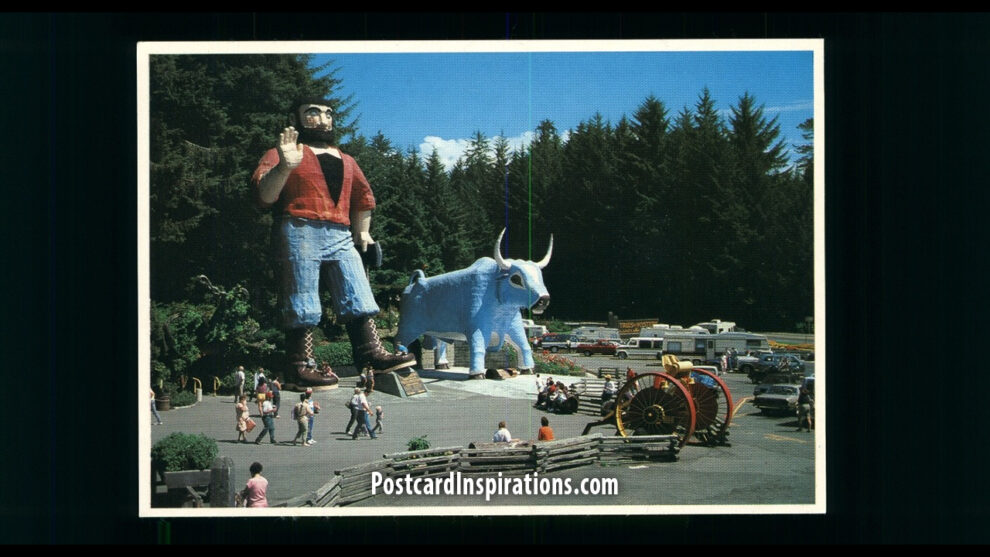
It takes us to Klamath, California, out on Highway 101, where the redwoods start feeling bigger, darker, and more endless the farther you go. In a landscape already full of giants, someone had the bright idea to put two more giants right beside the road, not hidden, not subtle, and not easy to forget.
Front and center is Paul Bunyan, towering over the parking lot like a welcoming host. Next to him is Babe the Blue Ox, just as bold, just as impossible to ignore. The text on the postcard even gives you the numbers, the kind of fun facts gift shops love to print because they make the whole thing feel official. Paul is listed as a 49-foot host. Babe is listed at 34 feet. The postcard calls it “tons of fun,” and that is the exact attitude these roadside stops were built on.
Trees of Mystery sits right in the middle of a classic American road trip tradition. Once cars became the normal way families traveled, highways turned into long strings of small towns, diners, motels, scenic pull-offs, and oddball attractions. Places along the road learned fast that beauty alone was not always enough. Travelers needed a reason to stop, stretch, take a photo, buy something small, and keep moving.
So America got creative.
Some places built huge signs. Some built strange museums. Some painted buildings to look like animals. In redwood country, where the trees already feel like something out of a story, it made perfect sense to lean into folklore. Paul Bunyan and Babe were already part of the tall tale tradition tied to timber and logging. Big trees, big work, big stories. Put those characters beside a real forest of massive trees, and you have a theme that feels right at home.
That is the magic trick. It turns a stretch of highway into a memory.
This postcard shows more than the statues. Look at the people walking around the base. Look at the cars lined up and the families moving across the open space. This was designed as a stop, not just a sign you glance at as you pass. It is a place where someone can take a picture that makes the kids laugh, where adults can stand in the same spot they stood decades ago, and where anyone can walk away with a souvenir that proves they were there.
For a long time, postcards were the easiest souvenir in the world.
You did not have to choose a size. You did not have to worry about packing it. You could buy it, write a note, and send it from the road. Or you could tuck it into a drawer at home and keep it as part of your own travel story. Postcards were travel-proof. They were a simple way to say, “We made it here, and it was worth stopping.”
That is why I always look at the back of a card like this, too, because it quietly tells you what era you are holding. This one has the crisp modern layout, a barcode, and that gift shop feel where postcards come from a rotating rack near the register. It even says it was made in Italy, which is a detail people miss, but it matters. A postcard can be about one small place on one stretch of highway, yet the printing and production can come from far away. Local memory, global printing, all meeting in a little rectangle of cardstock.
Even the tone of the wording on the back tells you something. It is upbeat, playful, and designed to make you smile. It calls Paul a host. It talks about him nodding, waving, and winking as he and Babe greet visitors. That is not an accident. It is selling a feeling. It is telling you that this is not a serious stop. This is a fun stop. A stop where you can be a tourist on purpose and enjoy it.
That is why this postcard is evergreen.
People still crave travel that feels simple. They want the kind of trip where you do not just race to a destination. You take the side road. You stop at the odd landmark. You take the picture. You find the gift shop. You laugh at something ridiculous and oversized, then you get back in the car and keep going with a better mood than you had twenty minutes earlier.
Trees of Mystery fits that perfectly because it lives in a setting that already feels special. Redwoods do not need help to impress anyone, but this place adds a different kind of wonder, the human kind, the kind built with paint and imagination and a sense of humor. It is one part forest, one part folklore, and one part road trip tradition.
Every time I look at this card, I picture someone doing the same thing people have done for years on Highway 101. You are driving through a wall of green, and then you see them, Paul and Babe, bigger than you expect, right there by the road.
And you pull over.
You walk around.
You take the photo.
Then you grab a postcard on the way out, because some things still work exactly the way they always did.
If you ever make it up that way, put Klamath on your list. Let the road surprise you. This postcard already did its job. It made you want to go.